Firearms
TL;DR
Geissele AR-15 upgrades can change trigger feel, handling, controls, or recoil-system behavior, but the right starting point depends on what you actually want to improve. For most general-purpose builds, the biggest practical differences come from the trigger, handguard, charging handle, and recoil system rather than replacing every part at once.
- All-around trigger pick — SSA: A balanced two-stage option with a published 4.25-4.75 lb total pull and a conventional curved bow.
- Precision trigger pick — SSA-E: Uses a lighter published 2.9-3.8 lb total pull for users who prefer a lighter second stage.
- Premium variants — SSA X / SSA-E X: Keep the familiar SSA-family pull profiles while adding Geissele's Lightning Bow shape and Nanoweapon coating.
- Rigid URG-I-style rail — SMR MK16: Uses 7000-series aluminum, a full top Picatinny rail, and M-LOK around the handguard.
- Slimmer rail choice — SMR MK14: Reduces overall diameter while keeping a rigid free-float layout and M-LOK at the 3, 6, and 9 o'clock positions.
- Modular rail choice — SMR MK8: Adds M-LOK at the upper 45-degree quadrants for users who want more mounting positions.
- Most noticeable control upgrade — Super Charging Handle: Ambidextrous controls, textured levers, and a raised rear lip designed to help mitigate gas blowback.
- Best recoil-system upgrade — Super 42: Uses a patented braided-wire spring design intended to improve spring consistency and reduce the familiar buffer-spring "twang."
Geissele AR-15 Upgrades: What This 2026 Guide Covers
Geissele AR-15 upgrades cover far more than triggers. In 2026, the company's catalog spans complete uppers, free-float rails, charging handles, buffer systems, lower-parts components, and armorer tools. That makes Geissele easy to browse but harder to narrow down when you only want the parts that will actually change how your rifle feels or functions.
This Gunvexa guide takes a practical route. Instead of treating every Geissele part as a must-have, we compare the upgrades that make the clearest difference, explain where similar products overlap, and point out where paying more gives you a real feature rather than just another model name.
In addition, the article separates published specifications from editorial judgment. We use manufacturer documentation for technical details, while our recommendations focus on use case, weight, controls, geometry, and how each product fits into the wider Geissele lineup.
If you are mainly researching triggers, read our Geissele G2S Trigger review. You can also browse more Geissele coverage on Gunvexa or visit the Gunvexa blog.
Gunvexa Editorial Methodology
This is a specification-based editorial buying guide, not a claim of independent laboratory testing. Gunvexa reviewed Geissele's published product information, technical support material, current rail catalog, trigger documentation, and company history. Where configurations or pricing can change, we describe the product family rather than presenting a temporary sale price as a permanent specification.

Geissele AR-15 Upgrades: Why The Brand Costs More
Geissele Automatics began in 2004 as a trigger manufacturer. According to the company's history, Geissele launched with the Hi-Speed National Match trigger for competitive rifle shooting. A Department of Defense request followed in 2005 and led to the Super Select-Fire trigger, or SSF.
That background matters because it explains why triggers remain central to the brand. However, a military or government connection by itself does not make every consumer part the best choice. What matters more to most buyers is how Geissele applies materials, geometry, coatings, and system-level compatibility across its commercial products.
What You Are Actually Paying For
On the handguard side, current MK16, MK14, and MK8 models use 7000-series aluminum and Type 3 hardcoat anodizing. Meanwhile, Geissele machines the Super Charging Handle from 7075-T6 aluminum. Geissele also uses its own barrel-nut systems, anti-rotation features, proprietary trigger geometry, and purpose-built buffer components.
More importantly, Geissele ties some parts closely to larger systems. For example, USASOC adopted the 13.5-inch MK16 for the URG-I program. Therefore, buyers who want a Geissele-style upper can choose components Geissele developed to work together instead of mixing unrelated parts and hoping the ergonomics line up.
Quick Answer
Is Geissele Always Worth The Extra Money?
No. The premium makes the most sense when you specifically value Geissele's trigger feel, rail geometry, material choices, integrated upper-receiver packages, or control design. If a standard part already works well for your use, replacing it simply because a more expensive option exists may offer little practical benefit.

Geissele AR-15 Upgrades: Which Trigger Fits Your Build?
For many owners, the trigger is the first Geissele upgrade they notice immediately. The SSA family is especially easy to compare because the main models fall into two pull-weight groups: the standard SSA-style profile and the lighter SSA-E-style profile.
The X versions do not simply create another pull-weight category. Instead, they pair the familiar SSA or SSA-E pull profile with Geissele's Lightning Bow shape and Nanoweapon coating. As a result, the choice is easier when you separate pull weight from trigger-bow shape and coating.
SSA VS. SSA X VS. SSA-E VS. SSA-E X
| Trigger | 1st Stage Pull | 2nd Stage Pull | Total Pull | Trigger Bow | Coating | Best Fit |
|---|---|---|---|---|---|---|
| SSA | 2.75-3 lb | 1.5-1.75 lb | 4.25-4.75 lb | M4 curved | Standard | General-purpose and duty-oriented use |
| SSA X | 2.75-3 lb | 1.5-1.75 lb | 4.25-4.75 lb | Lightning Bow | Nanoweapon | SSA feel with premium bow/coating |
| SSA-E | 2.0-2.5 lb | 0.9-1.3 lb | 2.9-3.8 lb | M4 curved | Standard | Precision-oriented and lighter-pull preference |
| SSA-E X | 2.0-2.5 lb | 0.9-1.3 lb | 2.9-3.8 lb | Lightning Bow | Nanoweapon | Premium lighter-pull configuration |
Which SSA Trigger Makes The Most Sense?
Start with the standard SSA if you want a clear two-stage trigger without chasing the lightest possible pull. Its 4.25-4.75 lb published range gives it a broader general-purpose character than the lighter SSA-E. For that reason, it is the easiest default recommendation in this group.
By contrast, the SSA-E is the better match when a lighter second stage is a priority. Its published total pull range drops to 2.9-3.8 lb. That does not automatically make it "better"; rather, it makes the trigger more specialized toward users who deliberately want the lighter profile.
If you already know that you prefer the Lightning Bow shape, the SSA X and SSA-E X make the decision simple. Choose the X model that matches the pull-weight family you wanted anyway. In other words, SSA X stays in the SSA performance category, while SSA-E X stays in the SSA-E category.
Flat Bow VS. Curved: Super Dynamic Series
The Super Dynamic line gives buyers another way to choose. Models such as the SD-C and SD-E use a flatter trigger face while keeping pull characteristics that broadly correspond to the SSA and SSA-E families. Therefore, finger-placement preference can matter as much as the published pull-weight number.
Some shooters like a curved bow because it naturally centers the finger. Others prefer a flatter face because they can place the finger slightly higher or lower and change leverage more deliberately. Neither shape is universally superior, so this is one area where ergonomics should drive the decision.
What About The G2S, SSP, And 3-Gun Triggers?
A buyer who wants a more value-focused two-stage option should also consider the G2S. It sits below the SSA in Geissele's lineup and remains a strong entry point for a conventional two-stage feel. Our separate G2S review goes deeper into that comparison.
Meanwhile, the SSP is Geissele's single-stage precision option, while the 3-Gun family is purpose-built around competition-oriented behavior. Those are better treated as alternatives to the SSA family rather than direct replacements because the trigger character is intentionally different.

Geissele Uppers: URG-I Near Clone VS. Super Duty
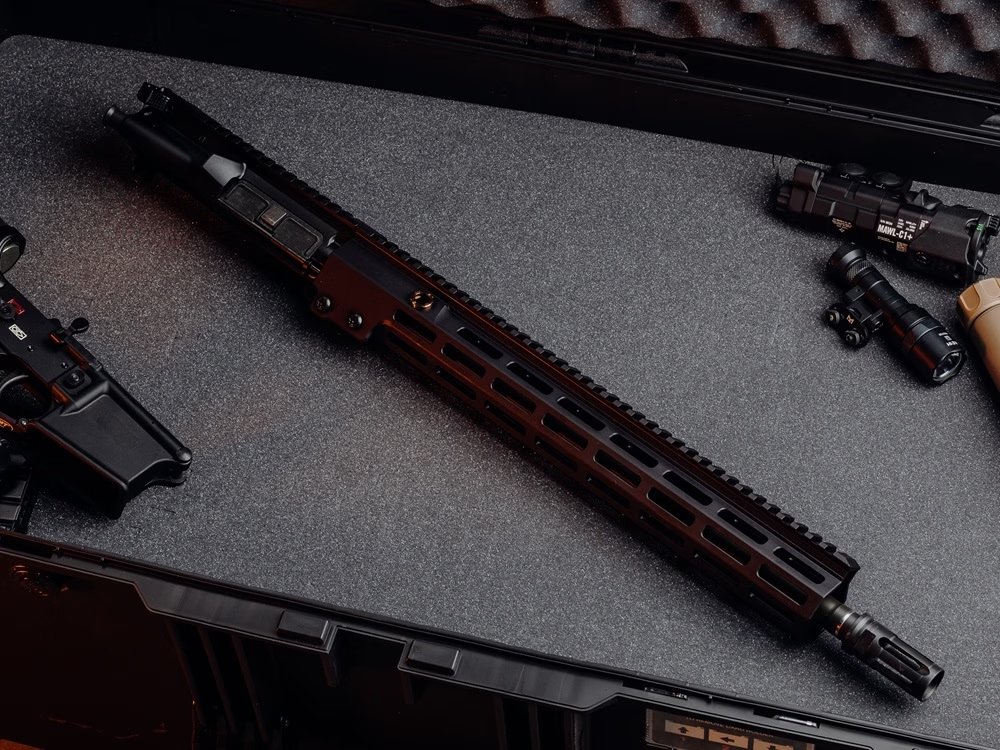
Among Geissele AR-15 upgrades, a complete upper is one of the biggest changes you can make. Geissele's upper-receiver choices make more sense when you first decide whether you want a clone-oriented configuration or a broader Geissele house build. The URG-I Near Clone family follows the general architecture associated with the Upper Receiver Group Improved program, while Super Duty gives Geissele more freedom to combine its own components and current production features.
URG-I Near-Clone Uppers
The URG-I is the more historically specific choice. USASOC adopted Geissele's 13.5-inch MK16 rail for the URG-I program, and the company's current site continues to feature URG-I Near Clone upper configurations. Consequently, this upper family makes the most sense for buyers who care about the URG-I design language, component lineage, and MK16-based handguard setup.
Current availability can change by barrel length, finish, and included components. Because of that, Gunvexa recommends checking the exact SKU before comparing one Near Clone listing with another. The important point is that "URG-I Near Clone" describes a configuration family, not one universal set of specifications that never changes.
Super Duty Uppers
Super Duty takes a less clone-focused approach. Instead of reproducing a specific program configuration, the line is built around Geissele's own current component ecosystem. That makes it the more natural choice for someone who wants a complete Geissele upper without caring whether every part matches a Near Clone reference.
In practice, the decision often comes down to intent. Choose URG-I when the program lineage and MK16-based Near Clone format are central to the project. Choose Super Duty when you want Geissele's integrated upper package and would rather prioritize the current product line than clone fidelity.
| Feature | URG-I Near Clone | Super Duty |
|---|---|---|
| Main Idea | Near-clone / URG-I-inspired configuration | Geissele's integrated house upper |
| Rail Focus | SMR MK16-based setup | Geissele rail system; exact configuration varies by SKU |
| Best For | Buyers who value URG-I lineage and configuration style | Buyers who want a complete current-production Geissele upper |
| What To Verify | Barrel length, muzzle device, BCG/charging-handle package | Barrel length, caliber, rail length, included components |
Configuration & Legal Note
Short-barreled upper configurations may be subject to firearm laws depending on the lower receiver, final configuration, and your location. Verify current federal, state, and local requirements before assembling or changing a firearm configuration. For installation or compatibility questions, follow the manufacturer's instructions or consult a qualified gunsmith.

Geissele AR-15 Upgrades: MK16, MK14, And MK8 Rails Compared
The MK16, MK14, and MK8 are all free-float M-LOK rails, yet they are not redundant. A better comparison starts with profile and mounting layout rather than treating one model number as automatically newer or better.
SMR MK16: The Rigid URG-I Choice
The MK16 is the strongest fit when you want the rail most closely associated with the URG-I program. Geissele machines it from 7000-series aluminum and uses anti-rotation tabs plus set screws to resist movement. In addition, the top carries a continuous M1913 Picatinny rail while M-LOK slots surround the handguard.
Geissele currently lists a 15-inch MK16 in its catalog and also offers shorter versions. Since the rail has a taller and slightly broader profile than the MK14, it suits buyers who prioritize rigidity and the URG-I style over the slimmest possible handguard.
SMR MK14: The Slimmer Option
The MK14 reduces diameter and overall height. Geissele's 15-inch specification lists a 2.02-inch height, 1.27-inch inner diameter, and 13-ounce weight with the barrel nut. Geissele places M-LOK at the 3, 6, and 9 o'clock locations.
As a result, the MK14 feels less bulky than the MK16 without abandoning the rigid Geissele barrel-nut design. It is the most straightforward pick here for a buyer whose priorities are a slimmer handguard and conventional M-LOK placement.
SMR MK8: More Mounting Around The Corners
The MK8 takes a different route. It uses M-LOK at the 3, 6, and 9 o'clock positions and also adds mounting points along the upper 45-degree quadrants. Geissele describes the MK8 as its ultra-modular model, which fits the rail's broader 2.11-inch distance-across-quadrants measurement on current 13.5-inch specifications.
Therefore, the MK8 is especially attractive when accessory placement matters more than keeping the rail as narrow as possible. The MK14 is slimmer, the MK16 is the URG-I-associated choice, and the MK8 leans hardest into mounting flexibility.
| Rail | Material | Mounting Layout | General Character | Best Fit |
|---|---|---|---|---|
| SMR MK16 | 7000-series aluminum | Full top Picatinny + M-LOK around the rail | Rigid, URG-I-associated profile | Hard-use / URG-I-inspired builds |
| SMR MK14 | 7000-series aluminum | M-LOK at 3, 6 and 9 o'clock | Slimmer diameter and lower overall height | Light, streamlined general-purpose builds |
| SMR MK8 | 7000-series aluminum | M-LOK at 3, 6, 9 plus upper 45° quadrants | More accessory-placement flexibility | Highly modular setups |

Geissele Charging Handles
A charging handle is a smaller upgrade than an upper or trigger, yet you can feel the change every time you manipulate the rifle. Geissele machines the Super Charging Handle, or SCH, from 7075-T6 aluminum and gives it an ambidextrous dual-lever design.
Contoured, textured levers improve purchase with bare hands or gloves. More notably, Geissele uses a heightened rear lip to help mitigate gas blowback toward the shooter on short-barreled or suppressed systems. That makes the SCH more than a cosmetic control change.
SCH VS. Airborne Charging Handle
The Airborne Charging Handle, or ACH, follows the same general ambidextrous idea but uses a lower-profile lever package. Consequently, the choice is mainly about how much gripping surface you want around optics, slings, and other equipment.
Choose The SCH If...
You prefer larger control surfaces, a more substantial grip, and a charging handle that is easy to reach with gloves or under a larger optic.
Choose The ACH If...
You want a lower-profile ambidextrous handle that reduces snag potential while retaining the same general premium-control concept.
Super 42 Spring, Buffer Weights, And Lower Parts Kits
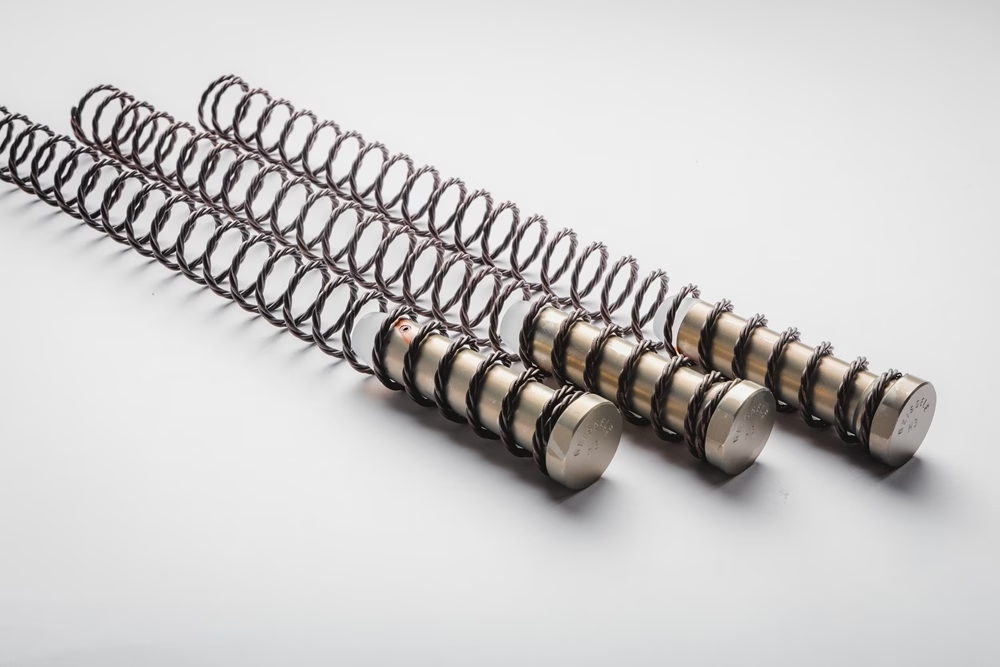
The Super 42 is one of the more distinctive small-part upgrades in Geissele's catalog. Instead of using one conventional spring wire, the design uses three independent strands. Geissele says the MG42 recoil spring inspired the concept, which acts as a harmonic damper.
According to Geissele's published material, the spring also has stronger average return force than a standard carbine spring and reduces the familiar spring reverberation heard through the stock. In practical terms, the Super 42 is best viewed as a system component rather than a stand-alone performance claim.
Which Buffer Weight Should You Use?
Buffer choice should follow the firearm's actual configuration, ammunition, gas system, and manufacturer guidance. A heavier buffer is not automatically an upgrade, and changing spring or buffer mass can alter cycling behavior. Therefore, avoid selecting a buffer weight only because a heavier model sounds more "duty grade."
Geissele's own support material notes that the company tunes Super Duty 5.56 systems around full-power 5.56 NATO-spec ammunition and that lower-pressure ammunition can change the balance. If reliability changes after a recoil-system modification, return to the manufacturer's recommended configuration or have the rifle checked by a qualified armorer.
Lower Parts Kits: Upgrade What You Will Notice
Complete lower-parts kits can be convenient when starting with a stripped receiver. However, an owner upgrading an existing lower may get more value by replacing only the controls or components that solve a real problem. That approach also prevents a simple upgrade from turning into an unnecessary full rebuild.

Geissele AR-15s: Super Duty Series
The Super Duty line is useful as a reference point even if you are upgrading a rifle rather than choosing a complete one. It shows how Geissele combines its trigger, handguard, charging-handle, barrel, bolt-carrier, and recoil-system ideas into one factory package.
In other words, a Super Duty gives you a picture of the company's preferred system approach. You do not need to copy every component on an existing AR-15, though. Instead, it can help identify which Geissele part matters most for the weakness you are actually trying to address.
When A Complete System Makes More Sense
A full system is easier to justify when you want integrated components from the beginning and do not already own a host rifle with parts you like. Conversely, upgrading one part at a time is usually more sensible when the existing rifle is reliable and you only want a different trigger feel, rail profile, control layout, or recoil system.
Gunvexa Take
Do You Need To Turn Your AR-15 Into A Super Duty Clone?
No. Choose upgrades by function. A trigger can change trigger feel, a rail can change weight and accessory placement, a charging handle can improve control access, and a recoil-system change can alter cycling behavior. Replacing unrelated parts simply to match a parts list can cost more without fixing anything you personally needed changed.
Geissele Tools: Which Do You Actually Need?
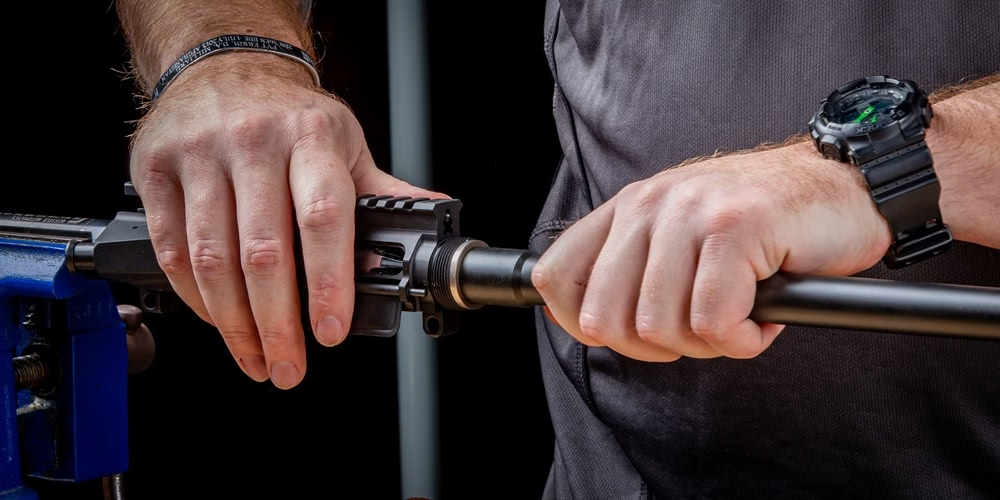
Geissele AR-15 upgrades sometimes require the correct support tools, especially when the work goes beyond a simple drop-in part. Geissele also sells armorer tools, including the Reaction Rod, trigger fitting pin, gas-block pin tools, and receiver-support products. These are shop tools for maintenance and parts work rather than performance upgrades.
The Reaction Rod supports an upper receiver through the barrel extension while the user performs maintenance or parts work. Geissele's AR15/M4 Armorer's Package combines that tool with a trigger fitting pin and gas-block pin tools. For someone who rarely changes parts, that package may be more equipment than necessary.
Buy Tools For The Work You Actually Do
If you routinely maintain several AR-platform rifles, dedicated support tools can make sense. On the other hand, occasional owners should not feel pressured to buy a full armorer setup just because it appears in the same catalog as the upgrade itself.
Most importantly, use the correct manufacturer instructions and torque specifications for any component work. If you do not have the right tools or experience for the job, a qualified gunsmith or armorer is the safer option.
Best Geissele AR-15 Upgrades By Goal
| Goal | Best Starting Point | Why |
|---|---|---|
| General-Purpose Trigger | SSA | Balanced two-stage pull without going as light as the SSA-E family |
| Lighter Precision Trigger | SSA-E | Lighter published total pull and second-stage range |
| Value Two-Stage Trigger | G2S | Lower entry point into Geissele's two-stage lineup |
| URG-I-Style Rail | SMR MK16 | Direct association with the URG-I program and rigid mounting design |
| Slimmer Handguard | SMR MK14 | Reduced diameter with straightforward M-LOK placement |
| Most Modular Rail Layout | SMR MK8 | Adds M-LOK on the upper 45-degree quadrants |
| Ambidextrous Control Upgrade | SCH / ACH | Improves charging-handle access from either side |
| Recoil-System Upgrade | Super 42 | Braided-wire spring design with a different return-force and vibration profile |
Gunvexa Verdict
Which Geissele AR-15 Upgrades Are Worth It In 2026?
The most worthwhile Geissele AR-15 upgrades are the ones that solve a specific problem. For most owners, start with the trigger if trigger feel is the weak point, the rail if weight or accessory placement needs work, or the charging handle if control access is the issue. Choose the URG-I or Super Duty upper only when a complete upper is what you actually need. That approach gives you the benefit of Geissele's design work without replacing functional parts simply for the name on the box.
Manufacturer Sources & Further Reading
Company History — Geissele Automatics
Technical & Trigger FAQ — Geissele Automatics
Super Modular Rail Catalog — Geissele Automatics
15-inch SMR MK16 Specifications — Geissele Automatics
15-inch SMR MK14 Specifications — Geissele Automatics
13.5-inch SMR MK8 Specifications — Geissele Automatics
AR15/M4 Armorer's Package — Geissele Automatics
Installation Guides & Technical Support — Geissele Automatics
FAQs
What Are The Best Geissele AR-15 Upgrades In 2026?
For most builds, the strongest starting points are an SSA or G2S trigger, an MK16/MK14/MK8 rail chosen by profile, an SCH or ACH charging handle for ambidextrous control, and the Super 42 when a compatible recoil-system change is actually needed.
What Is The Difference Between The Geissele SSA And SSA-E?
Both are two-stage triggers. Published pull weight is the main difference: the SSA runs 4.25-4.75 lb, while the SSA-E uses a lighter 2.9-3.8 lb range. For broader general-purpose use, the SSA is the easier default; users who deliberately prefer a lighter second stage may favor the SSA-E.
Which Geissele Rail Is Used On URG-I Uppers?
The Geissele SMR MK16 is the rail associated with the URG-I program. Geissele states that USASOC adopted the 13.5-inch MK16 for the URG-I program.
How Do The SMR MK16, MK14, And MK8 Differ?
The MK16 emphasizes rigidity and the URG-I-style layout, the MK14 uses a slimmer profile with M-LOK at 3, 6 and 9 o'clock, and the MK8 adds M-LOK on the upper 45-degree quadrants for more mounting flexibility.
More Geissele Upgrade Questions
Does The Geissele Super Charging Handle Help With Gas Blowback?
Geissele designs the SCH with a heightened rear lip intended to help mitigate gas blowback toward the shooter, particularly on short-barreled or suppressed setups. It does not eliminate every source of gas.
Will A Geissele Trigger Fit Every AR-15 Lower?
Compatibility depends on the exact trigger and receiver. Standard AR-15 small-pin receivers support many Geissele AR triggers, but non-standard or .308-pattern receivers can differ. Confirm the exact receiver and trigger specifications before purchase or installation.
Is The Geissele Super 42 Worth It?
It can be worthwhile when you want Geissele's braided-wire spring design and your rifle configuration is compatible with the intended spring and buffer setup. However, select buffer weight around the actual gas system, ammunition, and manufacturer guidance rather than simply choosing the heaviest option.
Should I Choose A URG-I Near Clone Or Super Duty Upper?
Choose URG-I Near Clone when the URG-I configuration and MK16-based lineage matter to you. Choose Super Duty when you want a current Geissele integrated upper and do not need the build to follow a Near Clone format.