Training
TL;DR
The Isosceles and Weaver are two of the best-known pistol shooting stances, but neither is automatically right for every shooter.
- Isosceles: Uses a more squared body position and generally feels simple and symmetrical.
- Weaver: Uses a more angled body position with a staggered lower-body setup.
- Balance matters: A useful stance should feel stable without forcing excessive tension through your knees, hips, shoulders, or back.
- There is no universal winner: Body type, mobility, training background, eyesight, and range activity all influence what feels natural.
- Best starting point: Compare both under safe range conditions and favor the position that produces repeatable balance and control.
A stable pistol stance gives the rest of your shooting fundamentals a consistent foundation. Grip, sight picture, visual focus, and trigger control all matter, but body position influences how comfortably and repeatably those elements come together.
Two names appear frequently when shooters discuss modern handgun positions: Isosceles and Weaver. They approach balance and body orientation differently, yet both have been used successfully for decades.
This Gunvexa guide compares the basic characteristics of the major pistol shooting stances, explains where the differences come from, and helps you identify factors worth considering during ordinary range practice.
Gunvexa Safety Note
Stance practice should always take place with the firearm pointed in a safe direction and in accordance with firearm, range, and instructor safety rules. New shooters should learn under qualified in-person supervision. Specialty close-range techniques require professional instruction rather than unsupervised experimentation.

A History of Pistol Shooting Stances
Handgun shooting positions have changed considerably over time. Early target and military traditions often emphasized one-handed shooting, with the shooter presenting the pistol from a more sideways body position.
As handgun training developed, two-handed shooting became increasingly common. Shooters and instructors experimented with ways to create greater stability while allowing the body to manage movement and recoil more naturally.
That development eventually produced several familiar approaches. The Weaver stance became especially influential during the rise of modern practical pistol shooting, while the Isosceles stance later became extremely common in competition, training, and general range use.
Why Stance Matters
A stance does not make up for poor fundamentals, but it affects the platform from which those fundamentals are applied. Poor balance can make the upper body work harder than necessary, while excessive rigidity may make movement uncomfortable.
The goal is generally to find a position that feels stable, repeatable, and compatible with your natural mobility.
Key Point
Stance Is a Foundation, Not a Shortcut
A useful stance supports good shooting habits, but accuracy still depends on consistent grip, visual alignment, trigger control, and safe practice.

Weaver Pistol Shooting Stance
The Weaver stance is easily recognized by its more angled body position. Rather than facing completely square to the target, the shooter generally stands with one side slightly farther back.
The lower body normally feels somewhat similar to an athletic or boxing-style position, with the feet staggered instead of perfectly even. The exact angle varies from shooter to shooter.
That bladed orientation is one of the Weaver stance's defining characteristics and is a major reason it feels different from Isosceles.
General Characteristics of Weaver
- Body positioned at a noticeable angle rather than completely square.
- Feet commonly arranged in a staggered athletic position.
- Knees kept comfortable rather than rigidly locked.
- Two-handed handgun position with the upper body oriented naturally toward the sights.
- Often feels familiar to shooters accustomed to bladed rifle or traditional athletic positions.
Why Some Shooters Prefer Weaver
Shooters who naturally favor a staggered stance may find Weaver comfortable because it resembles other athletic positions. It can also feel familiar to people whose previous shooting experience involved long guns.
The tradeoff is that the body position is less symmetrical. Some shooters therefore find it requires more conscious positioning when changing direction or moving between different range tasks.

Isosceles Pistol Shooting Stance
The Isosceles stance uses a more square relationship between the shooter's torso and the target. Both arms are presented forward in a comparatively symmetrical position.
When viewed from above, the extended arms and shoulders roughly resemble the triangular shape that gives the stance its name.
The lower body is commonly kept in an athletic, balanced position with the knees relaxed. Individual shooters may still offset one foot slightly for comfort, so modern Isosceles does not necessarily mean both feet must sit on exactly the same line.
General Characteristics of Isosceles
- Torso faces more squarely toward the target.
- Arms present the pistol in a relatively symmetrical position.
- Body weight remains balanced and athletic.
- Position is generally straightforward to reproduce.
- Commonly encountered in modern competition and general range instruction.
Why Some Shooters Prefer Isosceles
Many shooters find the Isosceles position intuitive because the torso, eyes, and arms all remain oriented more directly toward the target.
Its symmetry can also make the stance easier to repeat without requiring the shooter to reproduce a very specific body angle every time.
Isosceles vs Weaver Comparison
| Feature | Isosceles | Weaver |
|---|---|---|
| Torso Position | More square to the target | More angled or bladed |
| Foot Position | Generally balanced and relatively even | More noticeably staggered |
| Upper-Body Feel | More symmetrical | More asymmetrical |
| Learning Feel | Often feels simple and direct | Can feel familiar to shooters who like staggered athletic positions |
| Best Choice | Whichever allows the individual shooter to remain comfortable, balanced, safe, and consistent. | |
Isosceles May Suit You If
You prefer a square, symmetrical position and want a straightforward stance that is easy to reproduce during ordinary range practice.
Weaver May Suit You If
A staggered athletic position feels more natural and you are comfortable working from a slightly bladed body orientation.
Retention Shooting Stances
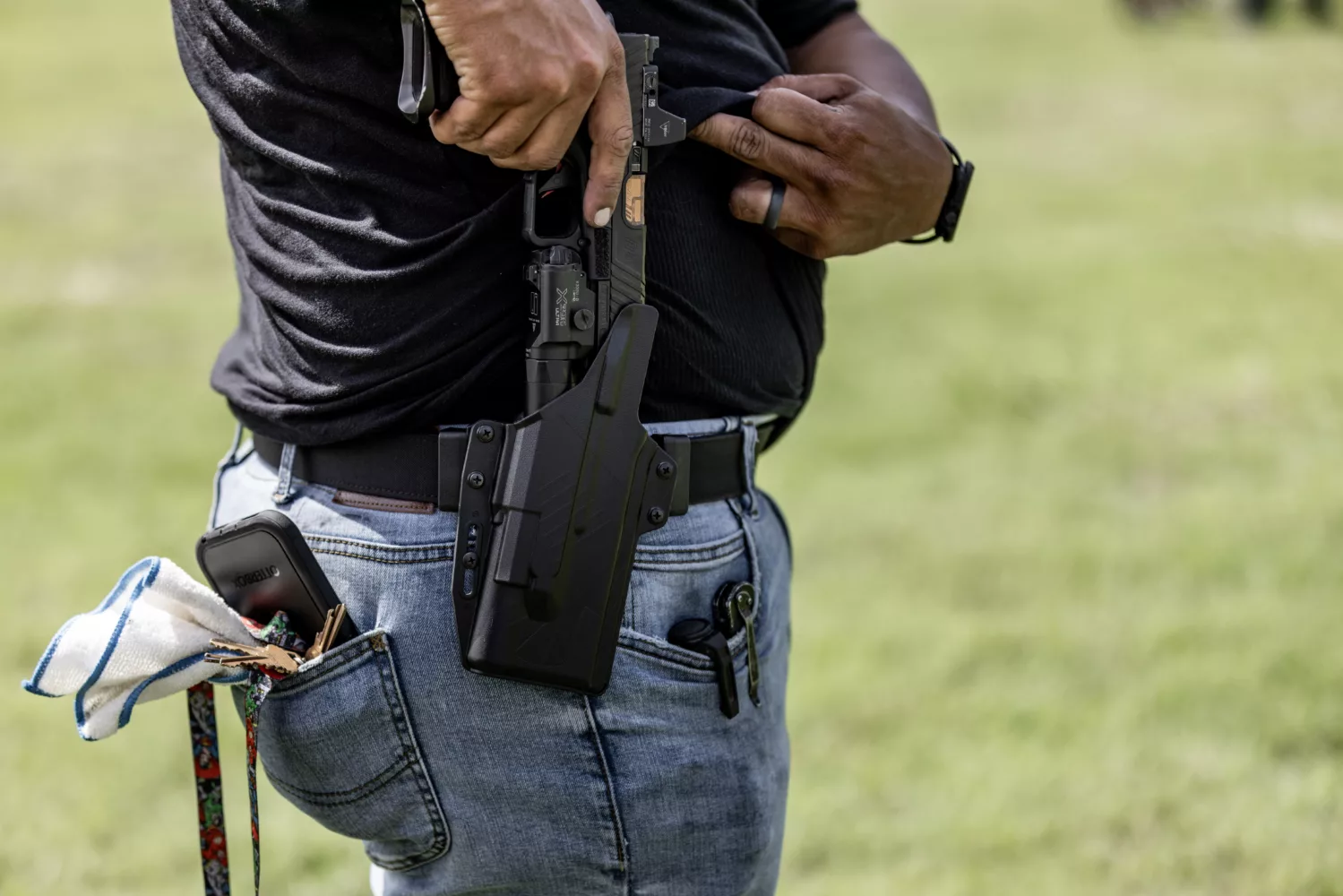
Retention positions are different from ordinary Isosceles and Weaver range stances. They are specialized close-range concepts intended for circumstances where extending the firearm normally would not be practical.
Because these positions involve reduced distance between the firearm and the shooter's body, mistakes can create serious safety hazards. They should not be treated as casual range techniques or learned solely from written descriptions.
Anyone interested in retention work should use a qualified instructor and a structured training environment. Proper coaching is particularly important for understanding safe muzzle direction, body position, movement, and range restrictions.
Safety Priority
Retention Requires In-Person Instruction
Unlike ordinary range stance comparison, close-range retention work should be learned under professional supervision rather than practiced independently from online instructions.

Choosing the Best Pistol Shooting Stance for You
There is no single pistol stance that fits every body type or every shooting discipline. Two people can use slightly different versions of the same stance and both remain balanced and comfortable.
Instead of trying to copy another shooter's exact posture, focus on a few fundamentals that help you evaluate whether a position works for you.
1. Balance
Your body should feel stable without requiring you to lean excessively or lock your joints. If small changes in foot placement dramatically improve comfort, use the position that gives you the better foundation.
2. Comfort and Mobility
Shoulder mobility, hip mobility, previous injuries, height, arm length, and general flexibility can all affect which stance feels natural.
A position that looks ideal on another shooter may not be ideal for your body.
3. Repeatability
A useful range stance should be easy to reproduce. If you constantly have to think about exactly where every joint needs to sit, the position may be more complicated than necessary.
4. Visual Alignment
Your stance also needs to allow a comfortable visual relationship with the sights. Shooters with different eye dominance or vision characteristics may naturally prefer slightly different head and shoulder positions.
5. Your Type of Practice
Static target practice, competition, instructor-led training, and other range activities can place different demands on body position. The stance that works best should match the type of shooting you actually do.
Quick Answer
Is Isosceles Better Than Weaver?
Not universally. Isosceles offers a straightforward, symmetrical body position, while Weaver uses a more angled and staggered setup. Compare both safely and choose the stance that gives you the most natural combination of balance, comfort, and consistency.

Conclusion
A good pistol stance gives your shooting fundamentals a stable base, but there is no reason every shooter needs to stand exactly the same way.
Isosceles uses a more square, symmetrical presentation and is extremely common in modern handgun training. Weaver uses a more angled body position and may feel more natural to shooters who prefer a staggered athletic stance.
Instead of choosing a stance because of its name, evaluate balance, comfort, joint position, visual alignment, and repeatability. Small personal adjustments are normal.
For new shooters, qualified instruction remains the most effective way to build safe fundamentals and determine which stance provides a solid foundation for continued range practice.
Gunvexa Bottom Line
Stability Beats Labels
The goal is not to reproduce a textbook pose perfectly. Use Isosceles, Weaver, or a comfortable variation that allows you to remain balanced, consistent, safe, and relaxed enough to apply the rest of your shooting fundamentals.
Frequently Asked Questions (FAQ)
What are the main pistol shooting stances?
Isosceles and Weaver are two of the most recognized modern two-handed pistol shooting stances. Shooters may also use modified versions based on body type, comfort, range activity, and instructor guidance.
What is the difference between Isosceles and Weaver?
Isosceles generally places the torso more squarely toward the target with a symmetrical upper-body position. Weaver uses a more angled torso and a more noticeably staggered stance.
Is Isosceles better for beginners?
Some beginners find Isosceles straightforward because of its symmetry, but comfort varies. A qualified instructor can help a new shooter compare positions and build a stable stance.
Is the Weaver stance outdated?
No. Although Isosceles is extremely common today, Weaver remains a recognized shooting stance and may still feel comfortable to shooters who prefer a staggered, angled body position.
Should my knees be locked in a pistol stance?
A rigid lower body is generally less comfortable than an athletic balanced position. Your knees should feel natural and supported rather than forced into an uncomfortable locked posture.
Can I modify a traditional pistol stance?
Yes. Shooters commonly make small adjustments for mobility, body proportions, eyesight, and comfort. The important factors are safety, balance, consistency, and good instruction.
Should I practice retention shooting by myself?
Specialty close-range retention techniques should be learned through qualified in-person instruction because incorrect body or muzzle positioning can create serious safety risks.