
Optics
TL;DR
The PLxC 2.5-20x48 Scope is a compact first-focal-plane optic built around a broad 2.5-20x magnification range, premium Japanese ED glass, a 34mm tube, interchangeable Steel-On-Steel cartridge turrets, and two precision-oriented ACSS reticle choices.
- Core strength: It combines a wide 2.5-20x magnification range with an 11.5-inch body, giving it a compact footprint for its class.
- Athena advantage: ACSS Athena BPR MIL G2 provides a full MIL-grid layout for users who prefer more reference points.
- DEKA advantage: ACSS DEKA G2 uses a simpler full-crosshair layout that leaves more of the image unobstructed.
- Turret advantage: The cartridge turret system provides configurable locking and overtravel-stop options with Steel-On-Steel 0.1 MIL adjustments.
- Bottom line: The PLxC 2.5-20x48 sits between the lighter 1.5-12x36 and higher-powered 4.5-36x56, making it the most balanced PLxC option for buyers who want compact dimensions without giving up substantial magnification.
PLxC 2.5-20x48 Scope Review: Quick Overview
The PLxC 2.5-20x48 Scope is one of the more interesting additions to the 2026 PLx Compact family because it tries to balance magnification, optical performance, and overall size rather than chasing only maximum power.
In addition, its 2.5-20x magnification range, 48mm objective, first focal plane design, Japanese ED glass, and 11.5-inch body place it directly between the smaller PLxC 1.5-12x36 and the larger PLxC 4.5-36x56.
More importantly, this Gunvexa review focuses on what buyers actually need to know in 2026: specifications, reticle choices, turret design, size and weight, optical features, advantages, drawbacks, and how the scope compares with the other new PLxC models.
For additional context, you can browse more PLxC coverage on Gunvexa or explore the latest Gunvexa optics guides .
Gunvexa Editorial Methodology
To keep the review transparent, this article uses a specification-based editorial approach. Specifically, Gunvexa checked published manufacturer specifications, product documentation, reticle information, and the positioning of the other PLxC models. However, we do not present laboratory measurements, durability tests, or hands-on observations that Gunvexa has not independently performed.

PLxC 2.5-20x48 Scope Specs: 2026 Rundown
The PLxC 2.5-20x48 Scope uses a first-focal-plane optical system with a 2.5-20x magnification range and 48mm objective. The main tube measures 34mm, while the optic itself is 11.5 inches long and weighs 30.05 ounces.
In addition, eye relief is listed at 3.2 inches on the low end and 3.7 inches at maximum magnification. The scope also uses 0.1 MIL adjustments, a CR2032 battery, illuminated reticles, and Primary Arms' AutoLive motion-sensing illumination system.
| Magnification Range | 2.5-20x |
|---|---|
| Objective Diameter | 48mm |
| Focal Plane | First Focal Plane |
| Main Tube / Mount Size | 34mm |
| Overall Length | 11.5 inches |
| Weight | 30.05 ounces |
| Eye Relief | 3.2-3.7 inches |
| Exit Pupil | 7mm low / 2.4mm high |
| Field Of View At 100 Yards | 46.7 ft low / 5.8 ft high |
| Click Value | 0.1 MIL |
| Elevation Adjustment | 100 MOA total |
| Windage Adjustment | 60 MOA total |
| Reticle Options | ACSS Athena BPR MIL G2 / ACSS DEKA G2 |
| Illumination | Illuminated with AutoLive |
| Battery | CR2032 |
| Warranty | Primary Arms Lifetime Warranty |
Is 2.5-20x A Useful Magnification Range?
First, the main attraction is versatility. At the low end, 2.5x gives the optic a much wider viewing experience than a conventional high-magnification precision scope. Meanwhile, 20x provides considerably more detail for distant target observation and precision-oriented range use.
However, that wide span is what gives this model its identity. It does not replace a true 1x LPVO for buyers whose priority is maximum low-power speed, and it does not offer the 36x ceiling of the larger PLxC. Instead, it occupies the middle ground.

What Makes The PLxC 2.5-20x48 Scope Different?
What makes this model stand out is not one isolated specification. Instead, the appeal comes from how several features are packaged together.
For image quality, Primary Arms uses Japanese ED glass in the PLxC line. ED, or Extra-Low Dispersion, glass is designed to reduce chromatic aberration and improve color separation, which becomes increasingly important as magnification rises.
In addition, the optic is first focal plane. As magnification changes, the reticle scales with the image. As a result, the reticle's angular references remain consistent throughout the magnification range.
Finally, another distinguishing feature is size. An 11.5-inch overall length is relatively compact for an optic reaching 20x. However, the 30.05-ounce weight means buyers should not confuse "compact" with exceptionally lightweight.
PLxC 2.5-20x48 Scope Pros And Cons
Pros
- Broad 2.5-20x magnification range
- First focal plane reticle system
- Premium Japanese ED glass
- Compact 11.5-inch overall length
- 34mm main tube
- Steel-On-Steel 0.1 MIL turret adjustments
- Interchangeable cartridge turret system
- AutoLive motion-sensing illumination
- Athena and DEKA reticle options
Cons
- 30.05 ounces is not especially light
- 2.5x does not offer true 1x performance
- Premium-tier pricing
- Requires a 34mm compatible mount
- Reticle choice requires deciding between a detailed grid and cleaner layout
- Buyers wanting maximum magnification may prefer the 4.5-36x56

What Are The PLxC 2.5-20x48 Interchangeable Cartridge Turrets?
One of the more unusual features on the PLxC 2.5-20x48 Scope is its interchangeable cartridge turret system. Primary Arms describes the system as user-configurable, allowing different turret configurations to provide locking and overtravel-stop functionality.
Meanwhile, the adjustment mechanism uses Steel-On-Steel construction and 0.1 MIL click values. For a premium optic, that repeatable mechanical interface is an important part of the design because the turret system is intended to provide a consistent tactile adjustment experience over the life of the scope.
Quick Answer
What Is The Main Turret Advantage?
As a result, the system gives the owner more configuration flexibility than a conventional fixed turret setup, while maintaining Primary Arms' Steel-On-Steel 0.1 MIL adjustment mechanism.
Which PLxC 2.5-20x48 Scope Reticle Should You Choose?
At present, the scope is offered with two MRAD-based reticle choices: ACSS Athena BPR MIL G2 and ACSS DEKA G2. Although both use a center aiming point and ranging references, their layouts are noticeably different.
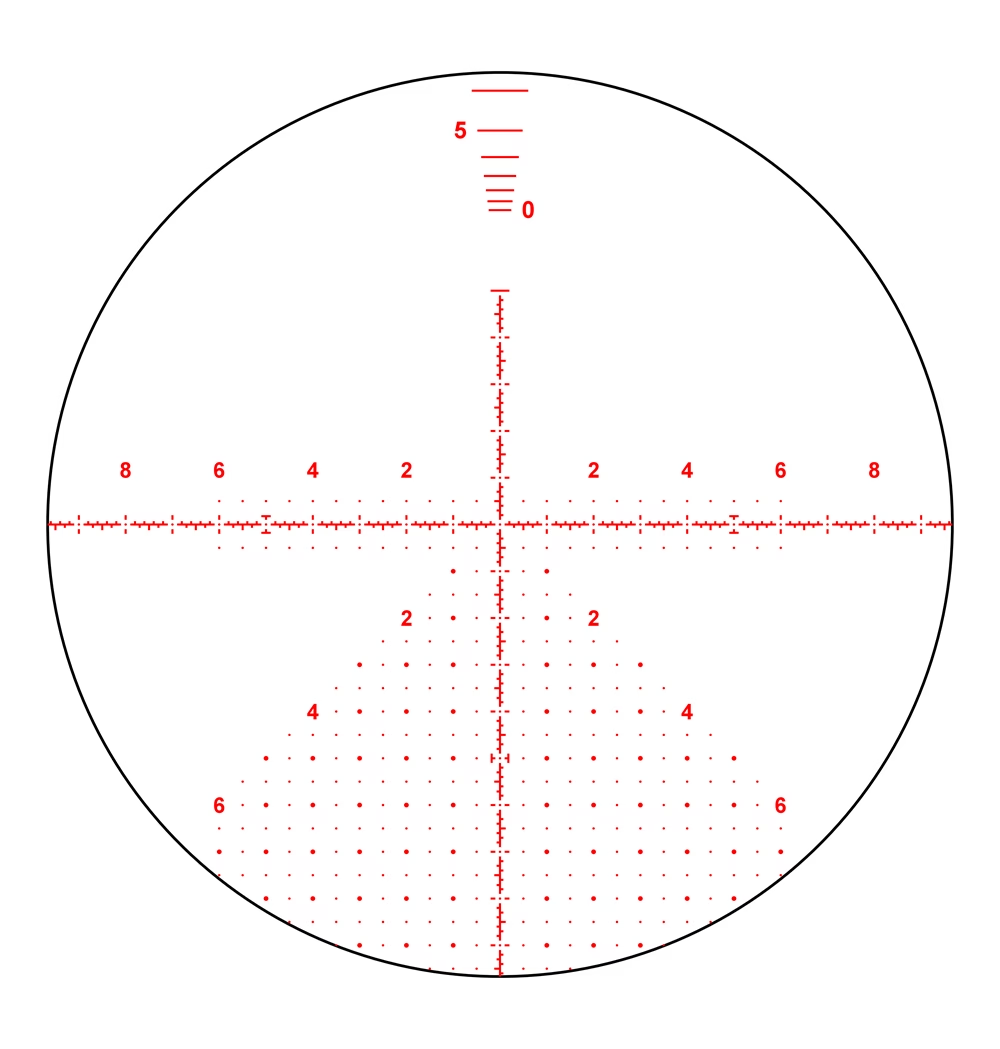
When To Choose The ACSS Athena BPR MIL G2
For shooters who want more visual data, the Athena is the more information-dense option. Its layout includes a center aiming point, a metric-based ranging ladder, and a full MIL-grid with additional stadia references.
Because it contains more visual reference points, it will appeal most to users who prefer a detailed grid and want more information visible inside the reticle rather than relying primarily on a simpler crosshair.
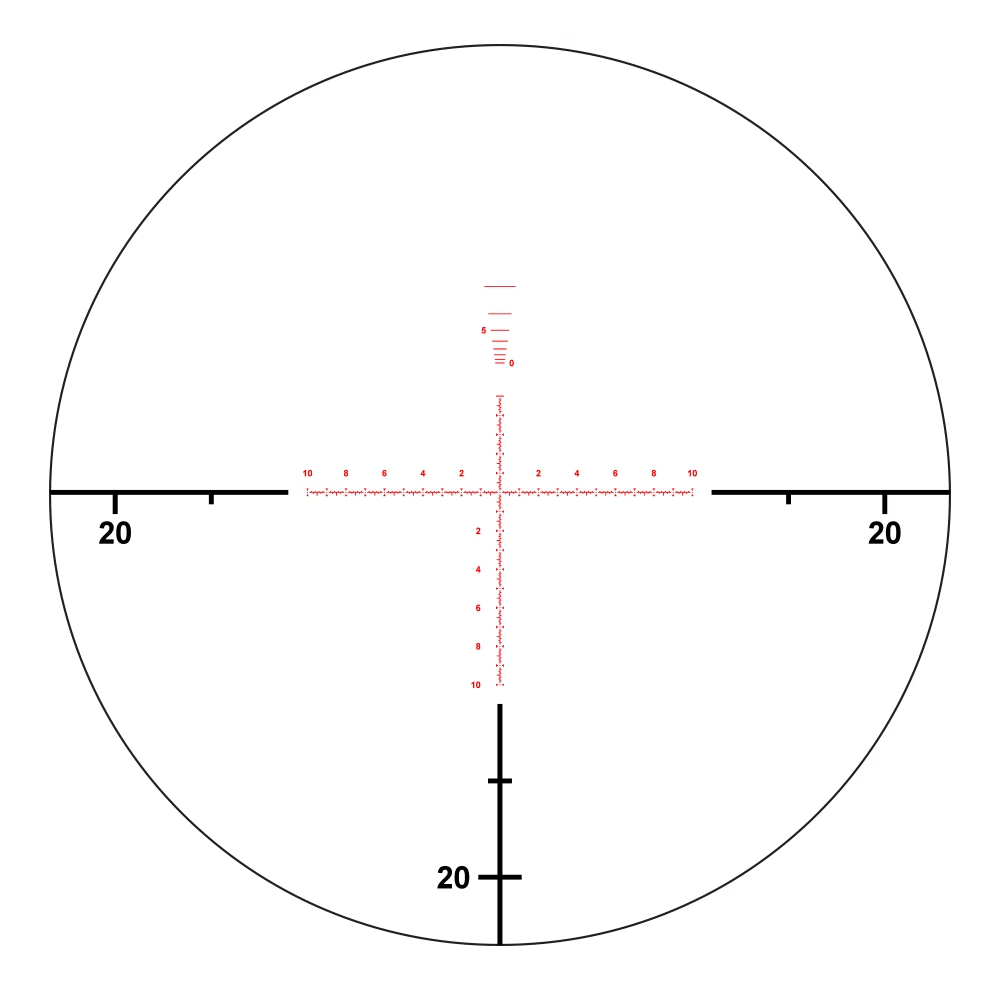
When To Choose The ACSS DEKA MIL G2
By contrast, the DEKA G2 takes a cleaner approach. Primary Arms describes it as a MIL crosshair reticle using 0.1 MIL subtensions, a center dot, a ranging ladder, and full MIL crosshairs.
Compared with Athena's larger grid, the DEKA layout leaves more of the target image visually open. Therefore, it makes sense for buyers who prefer simpler reticle presentation while still retaining MRAD references.
Choose Athena If...
You prefer a detailed MIL-grid with more visible reference points and a denser precision-oriented layout.
Choose DEKA If...
You want a cleaner crosshair-style presentation that preserves more open space around the central image.
How The PLxC 2.5-20x48 Scope Compares With Other PLxC Models
For context, the easiest way to understand the 2.5-20x48 is to place it between Primary Arms' other new compact variable optics. By comparison, the 1.5-12x36 emphasizes reduced size and weight, while the 4.5-36x56 prioritizes maximum magnification and a larger objective.

PLxC 1.5-12x36 FFP Rifle Scope
| Magnification | 1.5-12x |
|---|---|
| Objective | 36mm |
| Main Tube | 30mm |
| Length | 9.75 inches |
| Weight | 19.67 ounces |
| Eye Relief | 3.3-3.6 inches |
As a result, the 1.5-12x36 is clearly the lighter choice. At 19.67 ounces and 9.75 inches long, it removes a substantial amount of size and weight compared with the 2.5-20x48.
However, the tradeoff is top-end magnification. Its 12x maximum is considerably lower. Therefore, the two models target different priorities despite both being members of the PLxC family.

PLxC 4.5-36x56 FFP Rifle Scope
| Magnification | 4.5-36x |
|---|---|
| Objective | 56mm |
| Main Tube | 34mm |
| Length | 14.49 inches |
| Weight | 34.33 ounces |
| Eye Relief | 3.1-3.7 inches |
At the other end of the lineup, the 4.5-36x56 moves in the opposite direction. Its larger 56mm objective and 36x top end favor maximum magnification, while its 14.49-inch body and 34.33-ounce weight make it larger than the 2.5-20x48.
PLxC Scope Comparison
| Specification | PLxC 1.5-12x36 | PLxC 2.5-20x48 | PLxC 4.5-36x56 |
|---|---|---|---|
| Magnification | 1.5-12x | 2.5-20x | 4.5-36x |
| Objective | 36mm | 48mm | 56mm |
| Tube | 30mm | 34mm | 34mm |
| Length | 9.75 in | 11.5 in | 14.49 in |
| Weight | 19.67 oz | 30.05 oz | 34.33 oz |
| Eye Relief | 3.3-3.6 in | 3.2-3.7 in | 3.1-3.7 in |
| General Strength | Lowest size and weight | Broad middle-ground versatility | Maximum magnification |
Gunvexa Verdict
Is The PLxC 2.5-20x48 Scope Worth It In 2026?
Overall, it can be worth it, particularly for buyers who want the middle ground of the new PLxC lineup. Compared with the 1.5-12x36, the PLxC 2.5-20x48 Scope provides considerably more top-end magnification while staying shorter and lighter than the 4.5-36x56. In addition, its strongest selling points are its optical specification, compact 11.5-inch length, first-focal-plane reticles, and configurable turret system. However, premium pricing and a 30.05-ounce weight remain the main drawbacks because the optic is compact in dimensions but not especially light.
Manufacturer Sources & Further Reading
Official PLxC 2.5-20x48 — ACSS DEKA G2 Specifications
Official PLxC 2.5-20x48 — ACSS Athena BPR MIL G2 Specifications
2026 PLxC Product Overview — Primary Arms
Read more Gunvexa rifle scope guides .
FAQs
PLxC 2.5-20x48 Scope Questions
Is The PLxC 2.5-20x48 Scope First Focal Plane?
Yes. Because the PLxC 2.5-20x48 is a first-focal-plane scope, the reticle scales with magnification. As a result, its angular references remain proportional throughout the magnification range.
What Is The Magnification Range Of The PLxC 2.5-20x48?
Its magnification range is 2.5x to 20x. Therefore, it sits between the 1.5-12x36 and 4.5-36x56 models in the current PLxC lineup.
How Much Does The PLxC 2.5-20x48 Cost?
As of September 5, 2026, Primary Arms lists both the ACSS DEKA G2 and ACSS Athena BPR MIL G2 versions at $2,299.99. Retail pricing and availability can change, so check the current manufacturer listing before purchasing.
What Is The Difference Between Athena BPR MIL G2 And DEKA G2?
Athena uses a more detailed MIL-grid layout, while DEKA uses a cleaner MIL-crosshair design. Consequently, buyers who prefer more visual references may favor Athena, whereas those who want a less crowded sight picture may prefer DEKA.
Mounting And PLxC Model Comparisons
What Size Mount Does The PLxC 2.5-20x48 Require?
For mounting, the PLxC 2.5-20x48 uses a 34mm main tube. Therefore, it requires a compatible 34mm scope mount or rings.
How Does The PLxC 2.5-20x48 Compare With The PLxC 1.5-12x36?
By comparison, the 1.5-12x36 is much lighter and shorter at 19.67 ounces and 9.75 inches. Meanwhile, the 2.5-20x48 is heavier at 30.05 ounces but provides substantially more top-end magnification and a larger 48mm objective.
How Does The PLxC 2.5-20x48 Compare With The PLxC 4.5-36x56?
At the high-power end, the 4.5-36x56 offers substantially more magnification and a larger objective, but it is also longer and heavier. In contrast, the 2.5-20x48 is the more compact middle-ground option.
Does The PLxC 2.5-20x48 Have AutoLive?
Yes. In addition, Primary Arms lists AutoLive motion-sensing illumination as a standard feature. When the optic remains stationary, the system is designed to switch illumination off and then reactivate it when movement is detected.