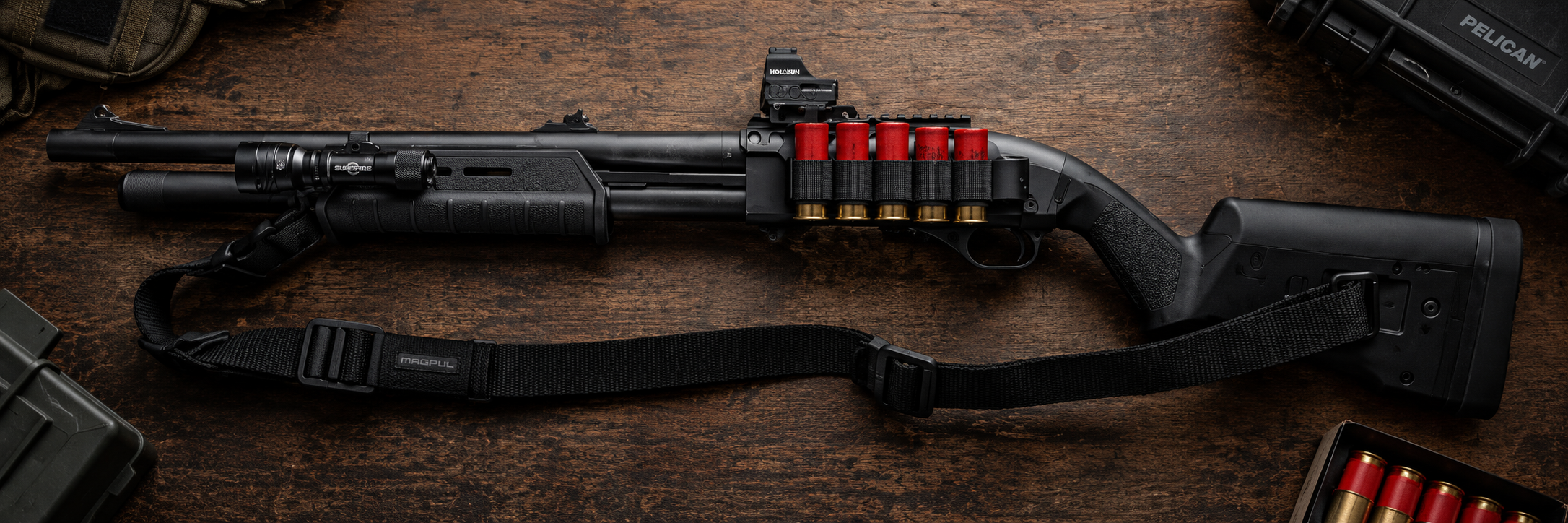
The best pump-action shotgun accessories are the upgrades that improve fit, visibility, carry, organization, or range-day convenience without making the shotgun unnecessarily heavy or complicated.
- Red dot sight: can make the sight picture easier to see and gives the shotgun a modern aiming option.
- Weapon light: useful where positive identification and low-light visibility matter.
- Sling: improves carry and keeps the shotgun secured when your hands need to be free.
- Side saddle: keeps spare shells organized on the shotgun for range or field use.
- Stock and forend: can improve fit, comfort, texture, and accessory compatibility.

Best Pump-Action Shotgun Accessories 2026: 5 Upgrades Worth Considering
Pump-action shotgun accessories can change how a shotgun feels, carries, and fits into a range or sporting setup. However, the most useful upgrades are usually not the most complicated ones. A red dot, a light, a sling, a side saddle, or more comfortable furniture can each address a different practical need.
In this 2026 Gunvexa guide, we compare five popular pump-action shotgun accessories and explain what each category can add to the platform. In addition, we look at compatibility, balance, comfort, and shopping considerations so you can decide which upgrades are worth prioritizing.
Exact compatibility varies by shotgun model, receiver, mounting system, stock pattern, and forend design. Therefore, always confirm the manufacturer’s fitment information before ordering parts or accessories.
This is a specification- and use-case-based editorial guide. Gunvexa compares accessory categories, published compatibility information, and practical ownership considerations. Always follow manufacturer instructions, keep the firearm unloaded while inspecting compatibility, and use a qualified gunsmith when installation or fitment is uncertain.
Understanding the Platform: The Pump-Action Shotgun
Pump-action shotguns have remained popular because their basic operating layout is simple, familiar, and adaptable. Even so, the way a shotgun is set up can vary widely. Some owners prefer a stripped-down configuration, while others add accessories that make the platform more comfortable or easier to use in specific settings.
Before buying pump-action shotgun accessories, start with the shotgun itself. Check whether the receiver is drilled and tapped, whether a Picatinny rail is already installed, whether the forend has M-LOK slots, what sling attachment points are present, and which stock pattern the shotgun uses.
Those details determine whether an accessory installs directly, requires an adapter, or simply is not compatible with the model you own. As a result, confirming fitment first can prevent unnecessary returns and extra spending.
| Accessory | Primary Benefit | What to Check Before Buying | Typical Tradeoff |
|---|---|---|---|
| Red Dot Sight | Modern, highly visible aiming reference | Receiver rail, mount height, footprint, battery access | Adds cost, height, and a small amount of weight |
| Weapon Light | Low-light visibility and identification | Mounting surface, switch placement, clearance | Adds weight toward the front of the shotgun |
| Sling | Carry and retention | Front and rear attachment points | Loose straps can snag if not adjusted well |
| Side Saddle | On-gun spare-shell storage | Receiver compatibility and shell retention | Adds bulk and weight to one side |
| Stock / Forend | Fit, comfort, grip and mounting options | Exact shotgun model and pattern | May require model-specific parts or installation |

#1. Pump-Action Shotgun Accessories: Red Dot Sights
Traditional bead sights remain simple and functional. However, a red dot gives the shooter a bright electronic aiming reference that can be easier to see in a wide range of lighting conditions. For that reason, optics are among the most noticeable pump-action shotgun accessories you can add.
When comparing red dots, look first at durability, mount compatibility, brightness controls, battery access, reticle size, and sight height. A shotgun does not necessarily need a large or complicated optic; a compact sight can often keep the setup lighter and less top-heavy.
Choosing Your First Red Dot Sight
MOA describes angular size and is commonly used to describe the apparent size of a red-dot reticle. Smaller dots provide a finer aiming reference, while larger dots are easier to notice quickly. Circle-dot reticles are another common option and may appeal to buyers who prefer a larger visual reference.
Instead of choosing a red dot by brand name alone, compare the mounting footprint, housing design, battery arrangement, warranty, and whether the sight can handle the recoil level specified by its manufacturer.

#2. Pump-Action Shotgun Accessories: Weapon Lights
A weapon-mounted light is another common shotgun accessory because it provides illumination without requiring the user to hold a separate flashlight. The most important considerations are secure mounting, easy switch access, beam quality, battery type, overall size, and durability.
Compatibility matters here because pump-action shotguns have moving forends. Therefore, a light or its cable should not interfere with the action. M-LOK-compatible forends can simplify mounting, while other shotguns may use dedicated clamps or model-specific light mounts.
Weapon Light Shopping Considerations
Lumens describe total light output, while candela gives an indication of beam intensity. Neither number should be considered in isolation. A well-balanced light for a shotgun should also have a practical size, secure mounting system, straightforward controls, and a beam pattern appropriate for the spaces where it will be used.
Before Buying a Shotgun Light
- Confirm that the mount fits the shotgun’s rail, M-LOK slot, or dedicated mounting point.
- Check that the light and switch do not obstruct the pump action.
- Consider how the added front-end weight changes balance.
- Verify the manufacturer’s recoil and environmental ratings.
- Choose a battery format you can source easily.

#3. Pump-Action Shotgun Accessories: Slings
Slings are easy to overlook, but they are among the simplest pump-action shotgun accessories for improving carry. A properly fitted sling keeps the shotgun attached to the user, spreads some of the load across the body, and can make longer range or field sessions more comfortable.
Types of Slings
Two-point slings attach at the front and rear and are the most conventional option for full-size long guns. Single-point slings use one attachment location and allow more movement, but they can let a longer firearm move around more freely when not supported.
Three-point designs use an additional length of webbing and can provide extra retention, although they are also more complex. For most buyers, the best starting point is simply a durable, adjustable sling that works with the shotgun’s existing attachment points.

#4. Pump-Action Shotgun Accessories: Side Saddles
A side saddle keeps spare shells organized on the shotgun itself. This can be convenient at the range, during training, or whenever you simply prefer to keep a small amount of ammunition stored with the shotgun rather than loose in a pocket or bag.
Hard Side Saddles vs. Soft Hook-and-Loop Cards
Rigid side saddles are commonly made from polymer or metal and attach directly to the receiver using a model-specific mounting system. Soft shell cards usually use elastic loops and hook-and-loop backing, making the card easy to remove and replace.
| Ammo Carrier | Description | Pros | Cons |
|---|---|---|---|
| Rigid Side Saddle | Polymer or metal carrier mounted directly to the receiver | Secure, durable and always attached to the shotgun | Can add more bulk and may require model-specific hardware |
| Hook-and-Loop Shell Card | Flexible elastic carrier attached using hook-and-loop backing | Lightweight, removable and easy to replace with another card | Adhesive-backed mounting surfaces can eventually require replacement |
#5. Pump-Action Shotgun Accessories: The Stock and Forend

Stocks
The stock affects how the shotgun meets the shoulder, where the face sits relative to the sights, and how comfortable the length of pull feels. Because body size and preferred shooting position vary, replacing a factory stock can make sense when the original dimensions do not fit well.
Before ordering a stock, confirm the exact shotgun model, receiver pattern, supplied hardware, recoil pad, sling mounting options, and whether the stock changes sight height or cheek position.

Forends
A replacement forend can change grip texture, profile, and accessory compatibility. Modern M-LOK-equipped designs are especially popular because they provide mounting slots without requiring a full-length accessory rail.
Even so, the forend is one of the more model-sensitive pump-action shotgun accessories. Action-tube length, shotgun generation, and receiver pattern can all affect fitment. Therefore, check the manufacturer’s compatibility list before purchasing.


Conclusion: Which Pump-Action Shotgun Accessories Are Worth Considering?
The best upgrade depends on what is missing from your current setup. If you want a clearer electronic sighting option, start with an optic. If low-light visibility is the priority, a light may make more sense. For carry, a sling is simple and useful. Side saddles help organize spare shells, while stock and forend upgrades are most valuable when fit or compatibility needs improvement.
Just as importantly, avoid adding accessories only because they are popular. Every extra component adds some combination of cost, weight, maintenance, or complexity. Therefore, the strongest 2026 setup is usually the one that solves a specific problem without making the shotgun harder to handle.
Which Upgrade Should You Start With?
Start with fit and compatibility. After that, prioritize the accessory that solves your biggest practical need: clearer aiming, better illumination, easier carry, organized spare shells, or more comfortable furniture. That approach makes it easier to build a balanced setup instead of simply adding more gear.
Safety and Compatibility Note
Before inspecting, fitting, or changing any shotgun accessory, make sure the firearm is completely unloaded and follow the manufacturer’s instructions. If an accessory requires receiver modification, specialized tools, or installation steps you are not comfortable performing, consult a qualified gunsmith.
Further Reading
Browse more Gunvexa shotgun accessory articles .
See more Gunvexa firearm and accessory guides .
Shop current products at the Gunvexa Shop .
Do I really need a red dot on a pump-action shotgun?
No. A bead or iron sight can remain perfectly functional. A red dot is simply an optional upgrade for buyers who prefer an electronic aiming reference and have a compatible mounting setup.
Will these pump-action shotgun accessories void my warranty?
Warranty treatment depends on the shotgun manufacturer and the type of modification. Accessories that install without permanent changes may be treated differently from drilling, cutting, or other modifications. Check the manufacturer’s current warranty terms before installation.
What should I check before buying a shotgun light?
Confirm mounting compatibility, switch access, clearance around the moving forend, battery type, overall weight, and whether the light is rated by its manufacturer for the recoil and environmental conditions you expect.
Is a two-point sling a good general-purpose choice?
A two-point sling is one of the most conventional choices for a full-size shotgun because it attaches at the front and rear and can be adjusted for carry. Exact fit depends on the shotgun’s sling mounting points.
Are rigid side saddles better than hook-and-loop shell cards?
Neither style is automatically better. Rigid carriers are permanently available on the shotgun, while flexible cards are lighter and easier to remove or replace. The better choice depends on how much bulk, weight, and modularity you want.